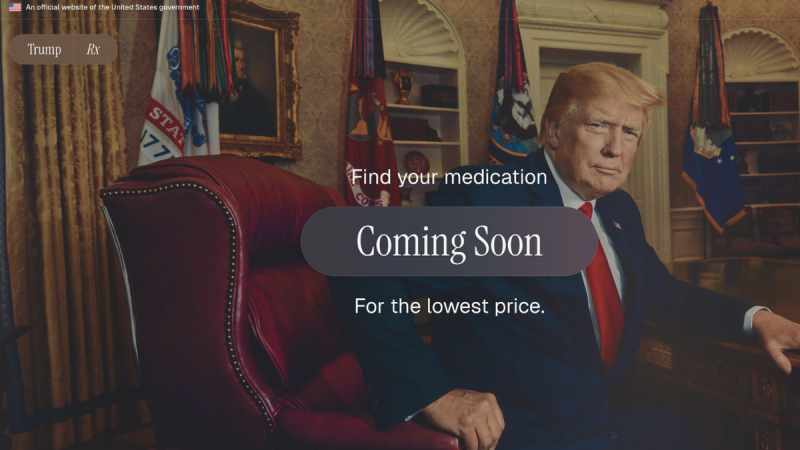
As President Donald Trump rolls out his TrumpRx proposal to cut prescription drug prices, economists are raising questions about what happens when prices are capped and whether short-term savings for consumers come at the expense of future medical breakthroughs.
On Friday, Trump announced deals with nine pharmaceutical companies to lower prices on certain medications for Americans, along with $150 billion in promised new investments in domestic manufacturing and pharmaceutical research.
The announcement builds on the administration’s Trump Rx initiative, a government-run portal designed to steer consumers toward lower-cost prescription drugs offered directly by manufacturers. The program is central to Trump’s effort to tie U.S. drug prices to those paid in other wealthy countries, a policy known as ‘most favored nation’ pricing.
But economists caution that price-lowering agreements don’t eliminate costs and often shift them elsewhere, particularly into reduced drug development, delayed innovation, or higher prices in other parts of the market.
Michael Baker, director of healthcare policy at the American Action Forum, said government price setting shifts costs rather than eliminating them.
‘At the most basic level, government price setting only limits what patients pay for a drug — usually reflected in an out-of-pocket or co-insurance payment,’ Baker said. ‘This does nothing to address the overall cost of the drug, which someone still has to pay, nor does it lower the cost associated with development.’
As a result, Baker said, patients ultimately bear those costs through tighter coverage rules, fewer treatment options or reduced future innovation.
‘Patients will experience far less of the crown jewel of the U.S. healthcare system that they are currently accustomed to receiving,’ he added.
Economists say the effects of permanent price caps would also be felt upstream, in research and development.
‘We know for sure that if drug prices are capped permanently below the levels the firm would have set, that will lead to lower incentives for R&D to discover new drugs and bring them to market,’ explained Mark V. Pauly, professor of healthcare management at The Wharton School at the University of Pennsylvania.
Pauly added that the impact is expected to be negative, but its scale — including how many drugs might never be developed and their potential value — remains highly uncertain.
‘I do not know the answer, but I know for sure no one else does either,’ he added.
Others argue the administration’s approach avoids the most damaging forms of price control.
Ed Haislmaier, an expert in healthcare policy and markets at The Heritage Foundation, said recent agreements appear to involve companies trading lower prices for benefits such as expanded market access or relief from other costs, including tariffs.
‘In such cases, companies are likely calculating that revenue losses from lower prices will be offset by revenue gains from more sales,’ Haislmaier told Fox News Digital.
‘The kind of government price controls that are most damaging to innovation are ones that limit the initial price a company can charge for a new product. That is the situation in some countries, but fortunately not yet the in the United States,’ he added.
Ryan Long, Paragon’s director of congressional relations and a senior research fellow, suggested that pricing pressure abroad could force foreign governments to shoulder a greater share of drug development costs.
Long said this strategy would lead ‘to lower prices for American consumers without sacrificing U.S. leadership in biopharmaceutical innovation that leads to new treatments and cures.’